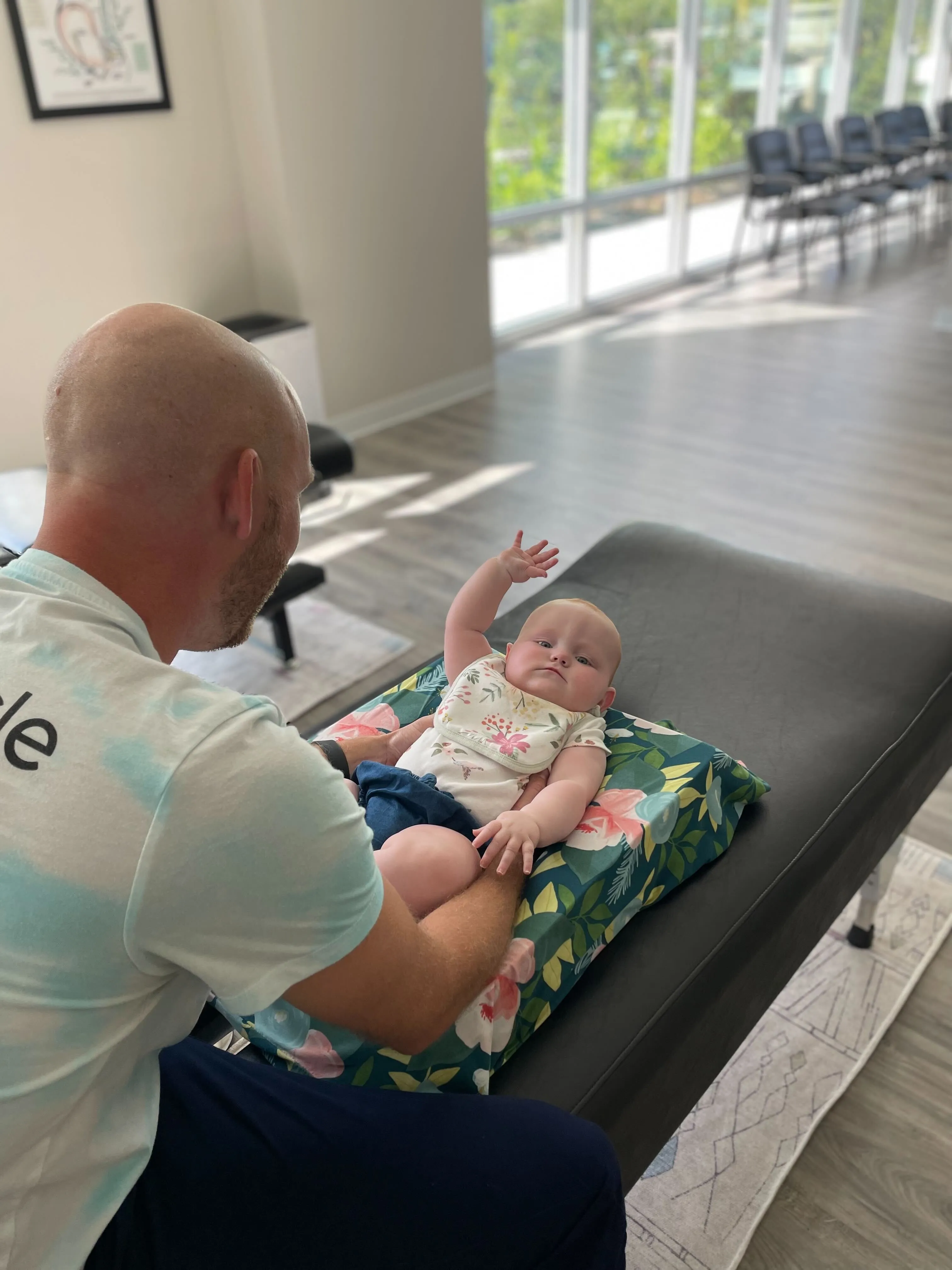
Positional Plagiocephaly vs. Craniosynostosis: What Lakewood Ranch Parents Need to Know
If you've noticed a flat spot on your baby's head, you're not alone — and you're probably wondering whether it's something that will round out on its own or something that needs urgent medical attention. The good news is that most flat spots are caused by positional plagiocephaly, a common condition that responds well to repositioning, tummy time, and pediatric chiropractic care. A much rarer cause, craniosynostosis, looks similar at first glance but works very differently and needs a different kind of care. Knowing which one you're dealing with — and when to loop in your pediatrician — can save you a lot of worry.
This guide walks through how the two conditions differ, what signs point to each, and what parents in Lakewood Ranch, Sarasota, Bradenton, and Parrish can do to support healthy head shape development.
Key Summary
• Positional plagiocephaly is a flattened area caused by repeated pressure on one part of a baby's soft, still-developing skull — it's common, not dangerous, and often improves with repositioning, tummy time, and pediatric chiropractic care.
• Craniosynostosis is a rare structural condition where one or more of the skull's growth sutures fuses too early, changing head shape in a way repositioning and chiropractic care cannot fix.
• A key difference: positional flattening usually shows up as a smoother, asymmetrical flat area, while craniosynostosis often comes with a firm ridge along a suture line and a head shape that doesn't respond to position changes.
• Most flat spots start to soften within weeks of consistent tummy time, position changes, and chiropractic care addressing the underlying neck tension; if you're not seeing any change after several weeks, it's worth a closer look.
• Craniosynostosis is diagnosed by a physician, sometimes with imaging, and may require surgical evaluation — this is not something repositioning or chiropractic care can resolve.
• Neurologically focused pediatric chiropractic care plays a key role in supporting positional plagiocephaly by directly addressing the muscular tension and movement preferences that contribute to it.
What Is Positional Plagiocephaly?
Positional plagiocephaly (sometimes called "flat head syndrome") is a flattened area on a baby's skull that develops from consistent pressure on one spot. A newborn's skull is made up of several separate bony plates connected by flexible, fibrous joints called sutures. This flexibility is a good thing — it allows the skull to pass through the birth canal and to grow rapidly during the first year of life — but it also means the skull is soft enough to be reshaped by sustained pressure.
Because babies spend so much time lying on their backs (which is the safest sleep position and should never be changed without a pediatrician's guidance), a flat spot commonly develops on the back or one side of the head. This is more common now that safe back-sleeping guidance is standard — a small trade-off most pediatric organizations consider well worth it, since flat spots are manageable while safe sleep positioning is protective.
A flat spot is often more than a cosmetic concern — it can be a visible sign of underlying tension in a baby's neck and upper back that makes turning comfortably toward both sides more difficult. This is exactly the kind of restriction that gentle infant chiropractic care is designed to help address, working alongside repositioning and tummy time rather than replacing them.
For a closer look at how gentle care can support this process, see our related article on how infant chiropractic care can help with plagiocephaly.
What Contributes to Positional Plagiocephaly
• Consistently sleeping with the head turned to one preferred side
• Limited tummy time or time upright off a flat surface
• Congenital muscular torticollis, a tightness in the neck muscles that makes turning the head to one side more comfortable than the other — learn how torticollis and flat head syndrome are connected
• Positioning in the womb, especially in multiples or babies who were positioned a certain way late in pregnancy
• Premature birth, since a preemie's skull is even softer and more time is often spent lying down in a NICU setting
Notice how many of these contributing factors come back to muscular tension and movement preference — which is exactly why addressing the underlying restriction, not just the flat spot itself, is such an important part of resolving positional plagiocephaly.
What Is Craniosynostosis?
Craniosynostosis is a structural birth condition in which one or more of the sutures in a baby's skull fuses together too early, before the brain has finished the rapid growth of early infancy. Because the affected suture can no longer expand, the skull tends to grow in an unusual pattern to compensate — often described as a specific, recognizable shape depending on which suture is involved, rather than a simple flat spot.
This condition is much less common than positional plagiocephaly and is not caused by sleep position or repositioning habits. It's typically identified by a pediatrician or pediatric specialist and, when treatment is needed, often involves surgical evaluation to allow normal skull and brain growth to continue. This is outside the scope of what repositioning, physical therapy, or chiropractic care can address, which is exactly why telling the two conditions apart matters.
How to Tell Them Apart
Here are some of the practical differences pediatric sources point to, though only a physician can make an actual diagnosis:
Shape and Symmetry
Positional plagiocephaly usually creates a smoother, parallelogram-like flattening, often with the ear on the flattened side pushed slightly forward and, sometimes, mild forehead asymmetry on the same side. Craniosynostosis tends to produce a more specific shape depending on which suture fused — for example, a long, narrow head, or a head that's unusually tall or triangular.
Ridging Along the Suture
A hard, raised ridge you can feel along a suture line is a hallmark that prompts further evaluation for craniosynostosis. A soft, smooth flat spot without a ridge is far more consistent with positional flattening.
Response to Repositioning
Positional plagiocephaly generally responds, at least partially, to consistent changes in sleep position, more tummy time, and reduced time in car seats or carriers — especially when paired with chiropractic care that addresses the underlying neck tension. Head shape changes from craniosynostosis do not improve with repositioning or chiropractic care, because the underlying cause is structural rather than pressure-related.
Timing
Positional flattening often becomes noticeable around 6–8 weeks of age and can worsen through 4–6 months before improving with intervention. Craniosynostosis is present from birth, though it isn't always obvious right away, and it may become more apparent as the baby's head grows over the following months.
Signs Parents Can Watch For
• A flat area on the back or one side of the head that seems to be getting more, not less, noticeable over several weeks
• A head shape that looks unusual from above (sometimes easiest to spot by looking down at the top of your baby's head)
• A firm ridge along a suture line, especially one that doesn't feel like it's softening
• A strong preference for turning the head one direction, or apparent difficulty turning it the other way
• Ears that are visibly out of alignment when viewed from behind
• No improvement after several weeks of consistent repositioning efforts
Any of these — especially a firm ridge or a head shape that isn't responding to repositioning — is worth bringing to your pediatrician sooner rather than later. Early evaluation gives the most options if further care is needed.
What Parents Can Do for Positional Plagiocephaly
• Have your baby evaluated by a pediatric chiropractor, especially if you notice a strong side preference or possible torticollis — addressing the underlying neck tension is often what makes the rest of this list actually work.
• Tummy time: Several short sessions a day while your baby is awake and supervised helps take pressure off the back of the head and builds neck and shoulder strength.
• Alternate head position during sleep: Within safe sleep guidelines, you can alternate which end of the crib is "up" or gently encourage your baby to turn their head the less-preferred direction as they settle.
• Limit time in car seats, swings, and carriers when you're not actually traveling, since these also place sustained pressure on the same spot.
• Change up positioning during feeding and holding so your baby isn't always resting their head the same way.
• Talk with your pediatrician about whether a referral for further evaluation or repositioning support makes sense, especially if flattening is moderate to severe or isn't improving by 4–6 months, since helmet therapy (when appropriate) tends to be most effective earlier in the first year.
• For more home strategies, see our guide on a natural approach to correcting a flat head.
The Nervous System Connection
One contributing factor to positional plagiocephaly that's often overlooked is muscular tension in the neck, frequently related to congenital muscular torticollis or general tightness from birth positioning. When a baby consistently favors one side because turning the other way feels restricted, the head naturally rests in the same spot over and over. Addressing that underlying tension — not just the flat spot itself — through pediatric chiropractic care can make repositioning efforts far more effective.
How Pinnacle Chiropractic Approaches This
At Pinnacle Chiropractic, we use INSiGHT neurological scans to assess patterns in the nervous system, including muscular tension and asymmetry that are contributing to a baby's head or neck positioning preferences — we measure, we don't guess. Gentle, infant-specific chiropractic adjustments (using pressure comparable to checking the ripeness of a tomato) are designed to release that tension and restore more balanced neck mobility, helping your baby turn comfortably toward both sides.
We're not able to diagnose or address craniosynostosis, and we'll always refer a family out for medical evaluation if we see signs that go beyond typical positional flattening. Our role is to directly address the musculoskeletal and neurological side of positional plagiocephaly, working alongside tummy time, pediatric guidance, and, when appropriate, physical therapy.
Frequently Asked Questions
Will my baby's flat head go away on its own?
Many mild cases improve on their own with consistent tummy time and repositioning, especially when addressed early. More moderate flattening often needs more deliberate intervention — including addressing any underlying neck tension with pediatric chiropractic care — and it's worth discussing with your pediatrician if you're not seeing improvement within several weeks.
At what age should I be concerned about a flat spot?
It's reasonable to mention any flattening to your pediatrician at any well visit, but flattening that is worsening, accompanied by a firm ridge, or not responding to repositioning by around 4–6 months is worth a more focused conversation sooner.
Can chiropractic care fix craniosynostosis?
No. Craniosynostosis is a structural condition involving the fusion of skull sutures and requires medical evaluation, sometimes including surgical care. Chiropractic care isn't a substitute for that evaluation, though it may be a helpful complement to medical care for a baby's overall neuromuscular comfort.
Does torticollis always cause plagiocephaly?
Not always, but the two are commonly connected, since a tight or restricted neck often leads a baby to rest their head in the same position repeatedly. Addressing torticollis early with pediatric chiropractic care can help prevent or reduce flattening.
Is helmet therapy always necessary?
No. Many babies improve with repositioning, tummy time, and chiropractic care addressing the underlying neck tension. Helmet therapy is generally considered for more moderate to severe cases, particularly when conservative measures haven't produced enough improvement, and it tends to work best when started earlier in infancy.
How can I tell if my baby has a preferred side?
Watch how your baby turns their head when lying on their back, and notice whether they consistently look toward one side more than the other, or resist turning fully to one side during tummy time or feeding.
Final Thoughts
A flat spot on your baby's head is a common concern, and in the vast majority of cases, it's positional plagiocephaly — something that responds well to simple, consistent changes at home and pediatric chiropractic care addressing the underlying tension. Knowing the signs that point toward the much rarer craniosynostosis helps you know when to ask for a closer look, so you can move forward with confidence either way.
If your baby is showing signs of a flat spot, a strong side preference, or possible torticollis, Pinnacle Chiropractic can help you better understand what may be contributing to it and address it directly. Our neurologically focused approach uses objective INSiGHT scans and gentle chiropractic adjustments designed specifically for infants. Pinnacle Chiropractic proudly serves families throughout Lakewood Ranch, Sarasota, Bradenton, and Parrish — contact us to schedule a consultation.



.webp)

.webp)