Messy Handwriting and Fine Motor Struggles: A Nervous System Perspective
A child who avoids writing, grips the pencil in a death grip, or produces letters that wander across the page can leave parents and teachers wondering whether it's laziness, a phase, or something deeper. At Pinnacle Chiropractic, we look at handwriting and fine motor struggles through a nervous system lens, since writing is one of the most coordinated things a child does: it asks the brain, eyes, shoulders, arms, and tiny hand muscles to work together.
Gentle pediatric chiropractic adjustments are designed to support nervous system function, which is part of why families dealing with stubborn handwriting and coordination challenges ask us about it. Here's what contributes, what to watch for, and how a chiropractic approach fits alongside occupational therapy and your child's school team.
Key Summary
• Handwriting depends on posture, shoulder stability, hand strength, vision, sensory processing, and motor planning, not just practice.
• Messy writing, fatigue, awkward pencil grip, and avoiding writing tasks are common signs of fine motor struggles.
• Common contributors include core and shoulder weakness, sensory processing differences, and delayed development of motor skills.
• Occupational therapy is often a valuable partner for handwriting, and chiropractic care can complement it.
• Pediatric chiropractic adjustments are designed to support nervous system function and can be one helpful piece of the picture.
Why Handwriting Is About More Than the Hand
Good handwriting starts well before the pencil touches the page. A child needs a stable trunk and shoulder to hold the arm steady, enough hand strength and finger control to manage the pencil, eyes that track from board to page, and a brain that can plan and sequence the movements. When any link is weak, writing becomes exhausting, and kids often respond by rushing, avoiding it, or pressing too hard.
Why This Matters
Handwriting struggles often affect more than penmanship. A child who is working that hard to form letters may have less energy left for spelling, ideas, and confidence, and some begin to dread school work. Looking at what's underneath the writing, rather than only asking a child to try harder, gives families a better path forward.
Common Contributing Factors
Fine motor struggles usually have several pieces. Common contributors include:
• Core and shoulder stability — a child who slumps or props their head on their arm often lacks the trunk strength that fine hand control depends on.
• Sensory processing differences — kids who are over- or under-responsive to touch and body position may press too hard or too lightly. Our guide to sensory processing explains more.
• Delayed motor development — skills like crawling and bilateral coordination lay the groundwork for later fine motor control; see our post on W-sitting, toe walking, and clumsiness.
• Retained primitive reflexes — reflexes that were meant to fade in infancy can sometimes interfere with coordination and posture when they linger.
• Visual-motor integration — the eye-hand coordination needed to copy letters and stay on the line.
• Neck and upper spine tension — tension in this area can affect head posture and shoulder movement during seated work.
Signs Parents May Notice
• Letters that vary widely in size, spacing, or shape.
• An unusual or very tight pencil grip, or a hand that tires quickly.
• Pressing so hard the paper tears, or writing so lightly it's hard to read.
• Avoiding writing, coloring, or drawing tasks.
• Difficulty with buttons, zippers, scissors, or tying shoes.
• Slouching, head-down posture, or constant shifting at the desk.
The Nervous System Connection
Fine motor control is a nervous system skill. The brain plans the movement, the spinal cord and nerves carry the signals, and the body sends feedback about position and pressure. When that loop runs smoothly, writing feels automatic; when it doesn't, every letter takes effort. At Pinnacle Chiropractic, we use objective INSiGHT scans — thermography, surface EMG, and heart rate variability — to get a measured picture of how a child's nervous system is functioning. We measure, we don't guess.
How Pinnacle Chiropractic Approaches Fine Motor Struggles
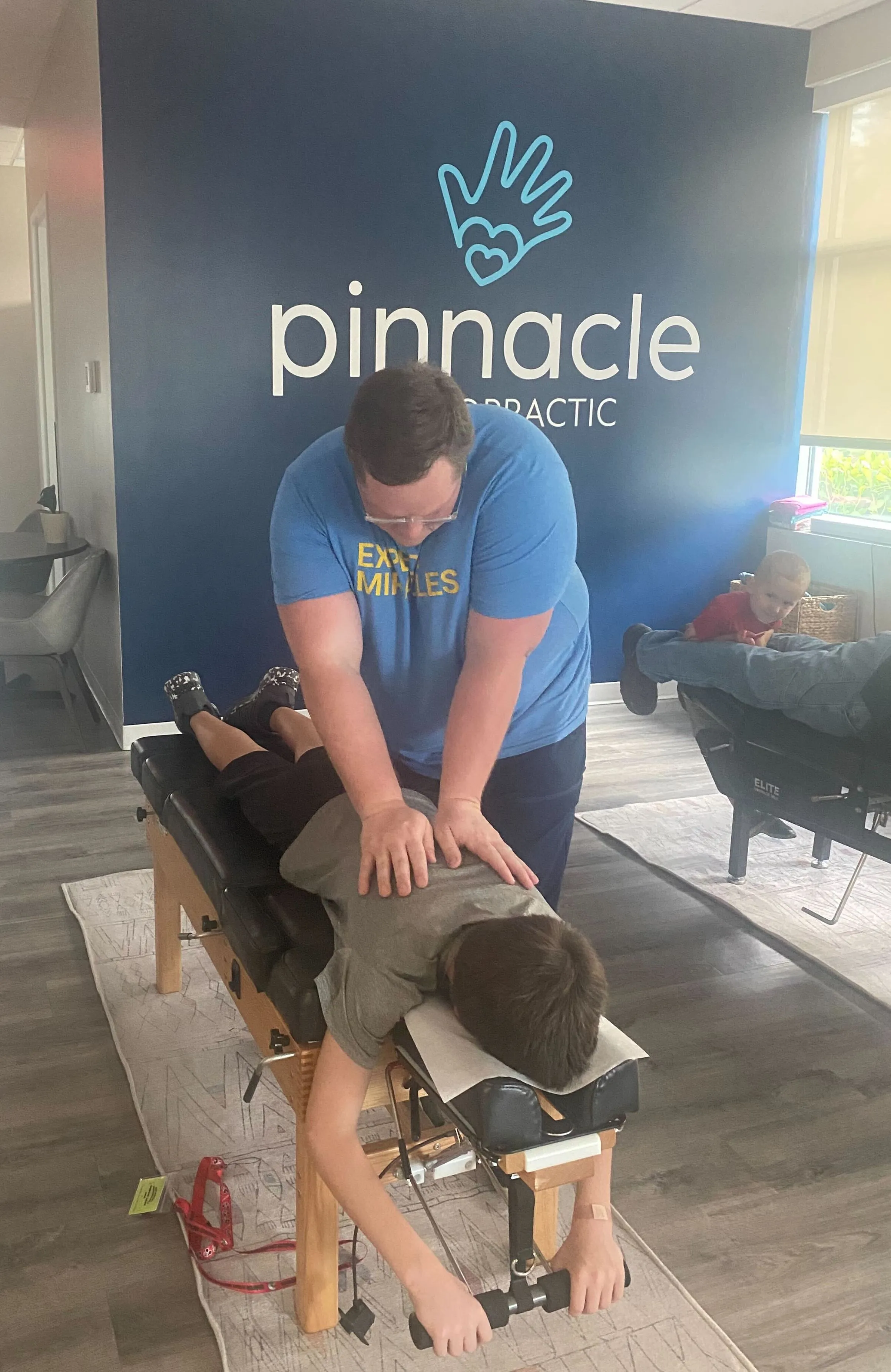
When a family in Lakewood Ranch, Sarasota, or Bradenton comes to us about handwriting or coordination, we start with a nervous system evaluation to assess tension and regulation patterns. Then we build a personalized care plan of gentle, age-appropriate pediatric chiropractic adjustments designed to support better nervous system communication. We see this as a partner to occupational therapy and classroom support, not a replacement. For more on motor skills generally, see our overview of developmental delays and our post on balance and coordination in children.
What Parents Can Do
• Build gross motor strength first: climbing, swinging, wheelbarrow walking, and monkey bars all feed fine motor skills.
• Offer play that strengthens hands, like playdough, tongs, clothespins, and LEGO.
• Set up a supportive workspace: feet flat, hips back, desk at elbow height.
• Try short, fun writing sessions rather than long drills.
• Talk with your child's teacher or an occupational therapist about targeted support.
• Consider a nervous system evaluation with a pediatric chiropractor to look at what may be contributing.
FAQs
Is messy handwriting normal for kids?
Some messiness is normal, especially in younger children and boys, since fine motor skills develop at different rates. It's worth a closer look when writing is painful, very exhausting, or well behind classmates.
Can handwriting problems be linked to the nervous system?
Yes. Writing relies on the brain, nerves, and muscles coordinating together, along with sensory feedback, so nervous system function is part of the picture.
Should my child see an occupational therapist?
If handwriting is a persistent struggle, an occupational therapist can assess grip, strength, and coordination and offer targeted strategies. Many families use OT alongside other supportive care.
Can chiropractic care help with fine motor skills?
Gentle pediatric chiropractic adjustments are designed to support nervous system function, which plays a role in coordination and posture. It works best alongside occupational therapy and school-based support.
What happens during a pediatric chiropractic visit for coordination concerns?
At Pinnacle Chiropractic, we start with INSiGHT neurological scans to objectively assess nervous system function, then use those results to build a personalized, gentle care plan for your child.
Final Thoughts
Handwriting struggles are rarely about effort. They're usually a window into posture, strength, sensory feedback, and nervous system coordination, and looking at those pieces together helps kids get the right support.
If your child struggles with handwriting or fine motor skills, Pinnacle Chiropractic can help you better understand what may be contributing to it. Our neurologically focused approach uses objective INSiGHT scans and gentle pediatric chiropractic adjustments designed specifically for children. Contact Pinnacle Chiropractic to schedule a consultation.



.webp)
.webp)